.webp)

Assassin’s Creed Valhalla is a game of immense scale, attempting to weave together the brutal reality of the Viking Age with the high-concept science fiction of the Isu and the Hidden Ones. As Eivor Varinsdottir, players navigate a beautifully rendered 9th-century England, building a settlement and forging alliances. However, beneath the surface of its stunning vistas and visceral combat lies a deep, fundamental issue: the "Structural Paradox of Identity." This is not a simple glitch or a balancing error, but a narrative and mechanical dissonance where the game’s desire to be a choice-driven RPG directly clashes with its established lore as a historical simulation.
This article explores the specific tension between Eivor’s role as a Viking Jarl and her place within the Assassin Brotherhood. We will analyze how the game’s "bloated" structure affects character development, the mechanical disconnect of the social stealth system, and the philosophical struggle of a protagonist who refuses to join the very order the franchise is named after. By examining these layers, we uncover why Valhalla represents both the peak and the breaking point of the "RPG-era" Assassin's Creed formula.
2. The Prologue of Ambition: Why Choice Undermines Canonical History
The issue begins in Norway with the introduction of the "DNA Stream" choice. Unlike Odyssey, where players chose a fixed character, Valhalla allows Eivor to be male, female, or "Let the Animus Decide." While this offers player agency, it introduces the first crack in the game's identity. The Animus is canonically a tool for viewing memories that already happened. By making Eivor’s very gender a fluid variable, the game shifts from "reliving history" to "constructing a sandbox," which thins the emotional consistency of the protagonist's journey.
This fluidity extends to the dialogue options and moral choices. In trying to cater to every player's whim, Eivor often lacks a definitive personality compared to predecessors like Ezio or Bayek. Because the narrative must account for a "merciful" Eivor and a "brutal" Eivor, the writing often settles for a middle-of-the-road stoicism that can make the long hours of the campaign feel emotionally stagnant. The paradox is clear: the more "choice" the player has, the less "character" the hero possesses.
3. The Alliance Map: How Structural Bloat Dilutes Narrative Urgency
Once Eivor reaches England, the game adopts a regional "Saga" structure. To progress, you must pledge to different territories on the Alliance Map. Mechanically, this is designed to give the player a sense of "conquering" England, but narratively, it creates a massive pacing issue. The search for Sigurd—the emotional heart of the game—is frequently sidelined for dozens of hours to help a local Ealdorman with a marriage dispute or a minor skirmish.
This "bloat" isn't just about length; it’s about the dilution of the "Assassin" identity. Because each territory is a self-contained story, the overarching plot involving the Order of the Ancients becomes a secondary concern. The player spends 80% of their time acting as a diplomat or a raider and only 20% acting as an Assassin. This structural choice forces the "hidden" part of the game into the periphery, making the Brotherhood feel like an optional hobby rather than a core tenet of the experience.
4. The Hidden Blade Dilemma: The Conflict of Viking Brute Force
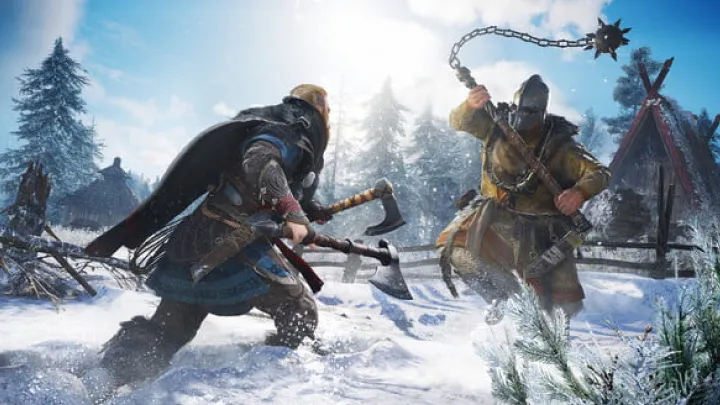
One of the most debated specific issues in Valhalla is the implementation of the Hidden Blade. Eivor wears the blade on top of her forearm—a stylistic choice that signals her refusal to fully commit to the Hidden Ones. This is a perfect metaphor for the gameplay: the game wants to be a stealth-action title, but the mechanics overwhelmingly favor loud, aggressive combat. The "Raiding" mechanic, which is necessary for settlement progression, explicitly forces the player into open warfare.
The Mechanical Disconnect:
- Social Stealth: The return of "crowd blending" feels hollow because the level design—mostly wide-open fields and small thatched-roof villages—rarely accommodates it.
- Guaranteed Assassination: Players must invest in a specific skill (Advanced Assassination) and succeed in a QTE (Quick Time Event) to kill high-level targets, a departure from the "one-shot" lethality that defines the fantasy of the blade.
- The Siren Song of the Axe: With a complex dual-wielding system and visceral finishers, the game rewards the player more for being a "Viking" than an "Assassin," rendering the franchise's namesake mechanics vestigial.
5. The Ravensthorpe Anchor: The Burden of the Settlement System
Ravensthorpe is the mechanical heart of Valhalla, a hub that grows as you raid monasteries. While the "Home Base" concept is a powerful motivator, it creates a narrative anchor that prevents the game from feeling like a true "Creed" journey. Traditional Assassin's Creed games are about the hunt and the pursuit across distances; Valhalla is about the "stay." Every time the story gains momentum, the player is incentivized to return home to build a bakery or a brewery.
This creates a clash between the "Nomadic Assassin" and the "Settled Jarl." The gameplay loop prioritizes the collection of supplies (Raw Materials) over the collection of intelligence. Consequently, the Order of the Ancients' members often feel like items on a checklist rather than dangerous conspirators. You aren't hunting them because they threaten the world; you are hunting them because their deaths provide the "Medallions" needed to unlock the next tier of your home base.
6. The Sigurd Paradox: A Protagonist Who Rejects the Creed
Perhaps the deepest narrative issue is Eivor’s relationship with the Hidden Ones, Basim and Hytham. Unlike almost every other protagonist in the series, Eivor never joins the Brotherhood. She explicitly rejects their tenets, viewing their way of life as dishonorable because they hide their faces. This creates a bizarre scenario where the player is playing an Assassin's Creed game as someone who thinks being an Assassin is cowardly.
This creates a vacuum where the "Creed" should be. Because Eivor doesn't believe in the Brotherhood's philosophy, the philosophical debates that usually drive the series (Order vs. Chaos) are one-sided. Eivor fights the Order of the Ancients not because she believes in freedom, but because they are a threat to her clan. This shifts the motivation from "universal justice" to "tribalism," which fundamentally alters the tone of the franchise’s moral compass.
7. The Isu and the Mythological Layers: Science Fiction vs. Fantasy
Valhalla takes a deep dive into Isu lore by framing it through the lens of Norse Mythology. Eivor’s "visions" of Asgard and Jotunheim are actually her processing her memories as the reincarnation of Odin (Havi). While this is a brilliant lore integration, it complicates the "Identity" issue. The player is forced to juggle three identities: the historical Eivor, the mythological Odin, and the modern-day Layla Hassan.
The Three Tiers of Reality:
- The Viking Reality: Forging alliances and raiding for resources.
- The Mythological Filter: Playing through "Odin’s" memories which are essentially a reskinned Isu history.
- The Modern Connection: Solving "Animus Anomalies" to reveal the truth of the "Great Catastrophe."
The issue arises when these layers overlap too much. The "World Events" (side quests) are often silly or surreal, clashing with the high-stakes Isu drama and the gritty political maneuvering of the main story. It makes the game feel like a collection of disparate ideas rather than a cohesive narrative.
8. The Order of the Ancients: Checklist Killings and the Loss of Mystery
In previous titles, assassinating a major target was a cinematic event with a "White Room" confession. In Valhalla, the "Menu-based" hunting of the Order of the Ancients turns these targets into nameless obstacles. Most members are "Zealots" who wander the roads or civilians you find by reading clues. While this is "realistic" in terms of detective work, it strips the antagonists of their presence.
When you finally do reach a "Main Branch" member, the impact is often lessened because you’ve spent the last ten hours doing unrelated tasks on the Alliance Map. The mystery of the "Grand Maegester" is easy to solve long before the reveal, making the eventual climax feel like a formality. The system prioritizes the "quantity" of targets over the "quality" of the kill, which is the antithesis of the original Assassin's Creed experience.
9. The Endgame and the Disappointment of the "Hidden" Ending
The conclusion of Eivor’s personal story and the "Order" story are separated by a vast amount of gameplay. To see the true ending of the Order of the Ancients, the player must hunt down every single member, which often requires 100+ hours of play. The reward for this is a conversation that, while lore-heavy, feels detached from the Viking epic the player has been living.
The "Hidden" ending—which connects Eivor to the broader Isu cycle—is arguably the most important part of the game’s story, yet it is tucked away behind optional "Anomalies." This means a large percentage of players finish the game feeling like the story was "incomplete" or "aimless." The identity of the game as a standalone Viking story and its identity as a chapter in the Isu saga are at constant war, with the player caught in the middle.
10. Legacy and the "RPG-Lite" Future: Lessons from Valhalla
Assassin’s Creed Valhalla is the ultimate expression of the "More is More" philosophy. It provides a massive, beautiful world and a combat system that is genuinely fun, but it loses the "Creed" in the process. The specific issue of "Identity Dissonance" arises because the game tries to be a historical Viking simulator and an Assassin lore-dump simultaneously, without fully committing to either.
The game's legacy will likely be defined by its success as a "Viking Fantasy" rather than an "Assassin's Creed." It proved that players love the world-building and the RPG mechanics, but it also highlighted a growing hunger for the "Social Stealth" and "Narrative Focus" of the older games. Valhalla is a masterpiece of scale, but it is also a cautionary tale about how structural bloat can obscure the heart of a franchise.
Conclusion
In conclusion, Assassin’s Creed Valhalla is a victim of its own ambition. The "Structural Paradox of Identity" prevents Eivor from ever truly feeling like an Assassin, while the rigid requirements of the franchise’s lore prevent the Viking story from reaching its full potential. By forcing a choice-driven RPG framework onto a fixed historical narrative, the game creates a beautiful but fractured experience. It is a world where you can be anyone, but as a result, the story of the Hidden Ones becomes just another whisper in the wind of the English countryside. Despite these issues, the game remains a landmark achievement in world-building, even if it leaves the "Creed" itself lurking in the shadows.
Valhalla's deep structural issue is the identity conflict between Viking gameplay and Assassin lore, leading to narrative bloat and a diluted protagonist arc.